Key takeaways
- To appear in an AI Overview, a page must be indexed by Google and eligible to show a snippet in search. Google says no other special optimisation is required.
- Ranking helps, but it’s not the whole story. In a March 2026 Ahrefs study, only 37.9% of pages cited in AI Overviews ranked in the top 10 for the original search.
- Google builds each AI Overview by running several related searches. Pages that answer those related questions have more chances to be cited.
- AI Overviews mostly appear on research questions. For a local business, that means the questions customers ask before they’re ready to call.
“There’s an AI answer at the top of Google for nearly everything in my industry now. How do I get my business into it?”
It’s a fair question, because that answer box is often the first thing a customer reads. If your competitor is cited there and you’re not, they’ve made the first impression.
The good news is that Google has published more about how AI Overviews work than most people realise, and there’s now solid research on which pages get cited. This guide puts the two together: what Google says you need, what the data shows about who gets cited, which searches trigger AI Overviews, and what you can do to improve your chances.
If you want the wider picture first, What is GEO? covers AI visibility across all the major tools. This guide focuses on Google.
1. What are AI Overviews, and how does Google pick the sources?
AI Overviews are AI-written summaries at the top of Google’s results, with links to the pages they draw on. To build one, Google runs several related searches behind the scenes, gathers pages from the results, and cites the ones that best support the answer.
According to Google’s documentation on AI features, AI Overviews are designed to help people get the gist of a complicated question quickly, and to give them a starting point to explore links. Google says they only appear when its systems decide they add something beyond the regular results.
The important part for business owners is how the sources are chosen. Google says AI Overviews and AI Mode may use a “query fan-out” technique: running several related searches across subtopics and data sources to build one response. So when a customer asks “how do I know if my geyser needs replacing?”, Google might also search for signs of geyser failure, typical geyser lifespans and repair versus replacement costs, then pull pages from all of those.
Google also notes that AI Overviews and AI Mode can use different models and techniques, so the answers and links they show will vary. Appearing in one doesn’t guarantee appearing in the other.
2. Do you need to rank in the top 10 to appear in AI Overviews?
It helps, but it’s no longer the whole story. In 2025, 76% of pages cited in AI Overviews ranked in Google’s top 10. By March 2026, that had fallen to 37.9%. Many cited pages rank for the related searches Google runs in the background, not the one the customer typed.
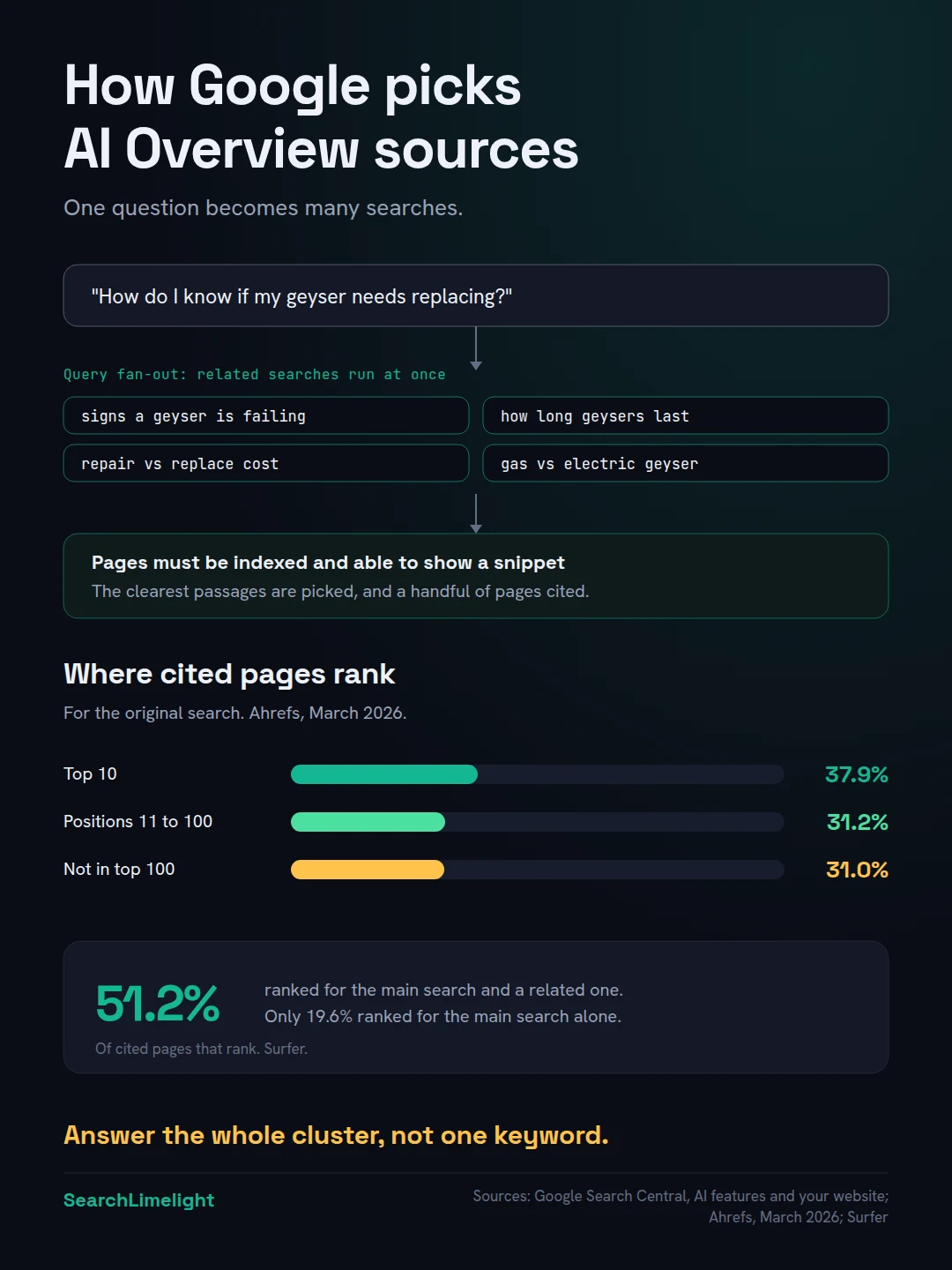
Ahrefs has studied this twice, and the change between the two studies is the key finding.
In 2025, Ahrefs analysed 1.9 million AI Overview citations. It found 76.1% of cited pages ranked in the top 10 for the same search. The most-cited page had a median ranking of position 2. At that point, ranking well and being cited went hand in hand.
In March 2026, Ahrefs ran the analysis again on a much larger set. This time:
- 37.9% of cited pages appeared in the top 10 results.
- 31.2% ranked between positions 11 and 100.
- 31.0% didn’t rank in the top 100 at all.
Ahrefs notes that part of the drop comes from better measurement. The bigger reason is query fan-out: Google draws on pages that rank for related searches, not just the main one.
Research from Surfer points the same way. In its analysis, of AI Overview citations that ranked in regular results, 51.2% ranked for the main search and at least one related search, while only 19.6% ranked for the main search alone.
What this means for you: ranking still matters, because Google has to find your page in its results. But ranking for one keyword isn’t enough. The pages that get cited tend to answer a whole cluster of related questions.
3. What does Google say you need to appear in AI Overviews?
Google says a page must be indexed and eligible to appear in Google Search with a snippet. There are no additional requirements and no special optimisations. You don’t need new AI files or special markup. The usual SEO fundamentals apply.
Google’s documentation is unusually direct on this. It says:
- To be eligible as a supporting link in AI Overviews or AI Mode, a page must be indexed and eligible to be shown in Google Search with a snippet.
- There are no additional technical requirements, and no special optimisations are necessary.
- You don’t need to create new machine-readable files, AI text files or markup.
- Indexing and serving aren’t guaranteed, even when a page meets every requirement.
Google then lists the SEO fundamentals that remain worthwhile. They include making sure crawling is allowed in robots.txt and by your hosting setup, making content easy to find through internal links, providing a good page experience, keeping important content in text form, and making sure any structured data matches what’s visible on the page.
One practical point: settings that stop Google showing a snippet of your page, like a “nosnippet” tag, can also limit how your content appears in AI features. If a developer has added these for another reason, check they aren’t on pages you want cited.
4. Which searches trigger AI Overviews?
Mostly questions and research searches, where a summary adds value. Google shows them far less on searches where someone clearly wants a specific local business right now. For most businesses, the opportunity is in the questions customers ask before they’re ready to buy.
Studies put AI Overviews on a large share of searches. Graphite’s analysis found they appear on roughly 30% of searches. But they’re far from evenly spread.
For local businesses, Whitespark’s 2025 study of 540 searches is the clearest picture. For research questions, like “how long does an eye exam take”, an AI Overview appeared 92% of the time. For clear local searches, like “plumber near me”, it appeared only 15% of the time, and the map pack dominated.
So think about the questions your customers ask while they’re still deciding:
| Business | Questions that often trigger AI Overviews |
|---|---|
| Plumber | “How long does a geyser last?”, “Why is my water pressure low?” |
| Dentist | “How much does a crown cost?”, “Is teeth whitening safe?” |
| Accountant | “When is the tax deadline?”, “Do I need to register for VAT?” |
| Physiotherapist | “How long does a sprained ankle take to heal?”, “Physio or chiropractor?” |
If your website answers these questions clearly and specifically, you have a real chance of being cited. And a customer who meets your business while researching is more likely to choose you when they’re ready.
5. How do you make your pages more likely to be cited?
Answer the main question and the related ones, put the answer first, use specific and checkable facts, keep pages up to date, and build a group of connected pages around each topic rather than one page that tries to cover everything.
Here’s what to focus on, based on Google’s guidance and the research above.
1. Cover the cluster, not just the keyword. Because Google fans out into related searches, build connected pages. A main page on geyser replacement, supported by pages on costs, warning signs, and gas versus electric, gives Google more chances to find you. Link them to each other.
2. Answer first. Open each section with a short, direct answer, then explain. We show how in How to write content AI actually quotes.
3. Be specific and original. Google’s own guidance on AI search stresses unique, non-commodity content. Your prices, local knowledge and real examples are exactly what generic pages lack.
4. Keep pages current. Update key pages when something real changes, like prices, regulations or services.
5. Make it easy to read. Clear headings, short paragraphs, and important information in text rather than in images or PDFs.
6. Support text with images and video. Google’s guidance on AI search encourages supporting your written content with good images and videos, because people increasingly search with pictures and their camera. For a local business, that might mean real photos of your work on service pages, or a short video showing how you do a common job. Make sure the key information is still in the text, so it can be read and quoted.
7. Build your reputation. An Ahrefs study of 75,000 brands found that mentions of a brand across the web were more closely linked to appearing in AI Overviews than backlinks were. Reviews, listings and local mentions all help.
6. Is being cited in an AI Overview worth it?
Yes, even though AI Overviews reduce clicks overall. Brands cited inside AI Overviews earn more clicks than brands that aren’t, and the citation puts your name in front of the customer at the moment they’re researching.
It’s true that AI Overviews take clicks. An Ahrefs study found the top-ranking page got 58% fewer clicks when an AI Overview appeared.
But the question isn’t whether AI Overviews exist. They do. The question is whether you’re in them. In Seer Interactive’s study of 3,119 searches, brands cited in AI Overviews earned 35% more organic clicks than brands that weren’t cited. Seer is careful to say this doesn’t prove the citation caused the extra clicks, but being cited and being chosen clearly go together.
There’s also a detail worth knowing: AI Overviews aren’t always at the very top. Ahrefs found that about 8.5% of the time, they appear lower on the page, and in those cases they took fewer clicks away.
7. How do you know if you’re appearing in AI Overviews?
Search your customers’ questions and look at the sources cited. Google Search Console includes AI Overview traffic in its normal reports but doesn’t separate it. For regular tracking, SEO tools like Ahrefs and Semrush can show which searches cite your pages.
- Check manually. Search the questions your customers ask, in a private window, and note whether your pages are cited. Repeat monthly, because citations change.
- Watch Search Console. Clicks and impressions from AI Overviews are counted within your Performance report. Rising impressions with flat clicks on question pages can be a sign AI Overviews are appearing.
- Use a tracking tool. Ahrefs Brand Radar and Semrush’s position tracking can show AI Overview citations across many searches.
How to check your AI visibility covers free methods and tools in more detail.
What to do this week
- List ten questions customers ask before they buy from you.
- Search each one on Google and note which trigger an AI Overview and which sites are cited.
- Check you have a clear answer on your site for each. Mark the gaps.
- Pick one topic and plan a main page with three supporting pages that link to each other.
- Check for “nosnippet” or noindex on pages you want cited. Search Console’s URL Inspection tool shows indexing status.
- Add a fresh, specific detail to one key page: a price range, a timeframe or a local example.
Frequently asked questions
How do I get my website into Google’s AI Overviews?
Make sure your pages are indexed and can show a snippet in Google Search. Google says there’s nothing else required. Then answer the questions your customers ask, clearly and early on each page, and cover related questions on connected pages, because Google draws on several related searches for each AI Overview.
Do I need to rank number one to appear in an AI Overview?
No. In Ahrefs’ March 2026 study, 37.9% of cited pages ranked in the top 10 for the original search, and the rest ranked lower or not at all. Many cited pages rank for the related searches Google runs in the background. Ranking well still improves your chances.
Do AI Overviews show up for local businesses?
Mostly for research questions, not for “near me” searches. In Whitespark’s 2025 study, AI Overviews appeared on 92% of local research questions but only 15% of clear local searches, where the map pack dominated. For local businesses, the opportunity is answering customers’ questions before they search for a provider.
Does schema markup help me appear in AI Overviews?
Google says no special markup is required. Structured data can still help Google understand your pages, and Google says it should match what’s visible on the page. Clear, specific, useful content matters far more than any markup.
Can I stop my content appearing in AI Overviews?
Google’s snippet controls, like the nosnippet tag, limit how your content is shown in search, including in AI features, but they also affect your regular search listings. The options have been under review, so check Google’s current documentation before making changes.
Are AI Overviews and AI Mode the same?
No. AI Overviews appear at the top of regular search results. AI Mode is a separate, conversational search experience for more complex questions. Google says they may use different models and techniques, so the answers and links they show will vary.
Do AI Overviews reduce my website traffic?
They can reduce clicks on the searches where they appear. Ahrefs found the top result got 58% fewer clicks when an AI Overview was present. But brands cited in AI Overviews earned 35% more organic clicks than those that weren’t, in Seer Interactive’s research. Being cited matters.
Want to know where you appear in AI Overviews?
Our free AI Visibility audit checks the questions your customers ask, shows which trigger AI Overviews, who’s cited, and which pages you’d need to be included.
Book a free discovery call and choose the audit that fits: AI Visibility & GEO, SEO, or Local Business SEO. No pitch until you’ve seen the gap.
Related reading
- How to write content AI actually quotes
- How to check your AI visibility: free methods and the tools worth paying for
- What is AEO? Answer engine optimisation, explained
About the author
Bantu Nonyukela is the founder of SearchLimelight. He has spent ten years in SEO, after starting out as a front-end developer, and is a Toptal-verified SEO expert. From Cape Town, he helps small and medium businesses in South Africa, the US, the UK and Australia get found in search and named by AI. Connect on LinkedIn
Sources
- Google Search Central, “AI features and your website”: developers.google.com
- Google Search Central, “Top ways to ensure your content performs well in Google’s AI experiences on Search,” May 2025: developers.google.com
- Ahrefs, AI Overview citations and search rankings, 1.9 million citations, 2025: ahrefs.com
- Ahrefs, AI Overview citations and the top 10, March 2026: ahrefs.com
- Surfer, “How to Rank in AI Overviews”: surferseo.com
- Whitespark, “The prevalence of AI Overviews in local search,” 2025: whitespark.ca
- Ahrefs, “An Analysis of AI Overview Brand Visibility Factors (75K Brands Studied)”: ahrefs.com
- Ahrefs, AI Overviews and click-through rate, December 2025 data: ahrefs.com
- Seer Interactive, reported by Search Engine Land: searchengineland.com
- Graphite and Similarweb: graphite.io
- Ahrefs, AI Overview positions and clicks: ahrefs.com