Key takeaways
- AEO stands for answer engine optimisation. It’s the work of making your business and content easy for search engines and AI tools to understand and present as a direct answer.
- AEO doesn’t replace SEO. Google says there are no extra requirements to appear in its AI features beyond the usual SEO basics.
- AEO and GEO overlap heavily, and there’s no agreed definition separating them. Microsoft’s 2026 guide draws a useful line: AEO is about clarity, GEO is about credibility.
- For a small business, think of it as one job with three layers: be found, be understood, be trusted.
“My marketing person says we need AEO now. Last month it was GEO. Are these different things, or is someone making up new letters to sell me something?”
A bit of both. The terms are real, and they point at a real change in how people find businesses. But the industry has produced new acronyms faster than clear explanations, and they’re often used to make ordinary work sound new.
This guide explains what AEO means, where it came from, how it differs from SEO and GEO, and what it actually involves for a small business. By the end, you’ll know what to ask for, and you’ll be able to spot when a proposal is dressing up basic SEO as something new.
If you haven’t read it yet, What is GEO? A plain-English guide for business owners covers the closely related idea.
1. What is AEO?
AEO, or answer engine optimisation, is the work of making your content and business information easy for “answer engines” to find, understand and present as a direct answer. Answer engines are any tools that answer a question rather than just listing links: Google’s AI Overviews, ChatGPT, Perplexity, Copilot and voice assistants.
Here’s the difference in practice. With a classic search, the customer gets a list of links and does the work of reading and comparing. With an answer engine, the tool does that work and gives the customer an answer.
Ask “what time does the hardware store on Main Road close?” and a voice assistant reads out a time. Ask ChatGPT “how much does a geyser replacement cost in Cape Town?” and it writes a short explanation. In both cases, the tool has picked information from somewhere and presented it as the answer.
AEO is about making sure that when the answer involves your business, the tool can find the right facts, understand them, and present them correctly.
2. Where did AEO come from?
AEO is older than GEO. The term was in use years before ChatGPT, when the goal was winning Google’s featured snippets, the answer boxes at the top of results, and being the answer read out by voice assistants. AI tools have made the idea much more important.
Before AI chat tools arrived, Google had already started answering some questions directly, with featured snippets and knowledge panels. Voice assistants like Siri, Alexa and Google Assistant went further: they read one answer aloud. There was no list of ten links to rank in. You were the answer or you weren’t.
That’s where AEO started. The advice then was much like it is now: answer questions directly, structure your content clearly, and make your facts easy to pick out.
What changed is scale. AI tools now answer a far wider range of questions, including the ones that matter most to businesses: “who should I hire?” and “which one is best?” So an old idea has become a much bigger deal.
3. What’s the difference between AEO and SEO?
SEO aims to rank your pages so people click through. AEO aims to have your information chosen and presented as the answer itself. They share almost the same foundation. Google says its AI features need no special optimisation beyond good SEO, so AEO builds on SEO rather than replacing it.
| SEO | AEO | |
|---|---|---|
| The goal | Rank a page high in the results | Be the answer the tool presents |
| What the customer sees | A list of links | A direct answer, spoken or written |
| What wins | Relevant pages, links, a healthy website | Clear, direct answers and facts that are easy to pick out |
| How you measure it | Rankings, clicks, enquiries | Whether you’re the answer, and whether it’s correct |
Will AEO replace SEO? No, and Google’s own documentation is direct about why. In its guidance on AI features, Google says there are no additional requirements to appear in AI Overviews or AI Mode, and no special optimisations are necessary. To be shown as a supporting link, a page simply has to be indexed and eligible to appear in Google Search with a snippet. Google also says you don’t need to create new machine-readable files, AI text files or special markup.
In other words, for Google at least, the foundation of AEO is SEO. If search engines can’t find and read your pages, answer engines that rely on them can’t either.
4. What’s the difference between AEO and GEO?
There’s no agreed definition, and many people use the two terms to mean the same thing. The clearest distinction comes from Microsoft’s 2026 guide: AEO is about clarity, so AI can read and present your facts accurately. GEO is about credibility, so AI trusts you enough to recommend you.
Honestly, the terms are used loosely. Some agencies say AEO, some say GEO, some say both, and they often mean the same work. There’s no official standard.
But in January 2026, Microsoft Advertising published a guide that separates them in a way that’s genuinely useful. As Search Engine Journal summarised it, Microsoft defines AEO as making information easy for AI assistants and agents to find, interpret and present as direct answers. It defines GEO as making content discoverable and persuasive in generative AI by increasing clarity, trustworthiness and authority. Microsoft’s own shorthand: AEO drives clarity, GEO drives credibility.
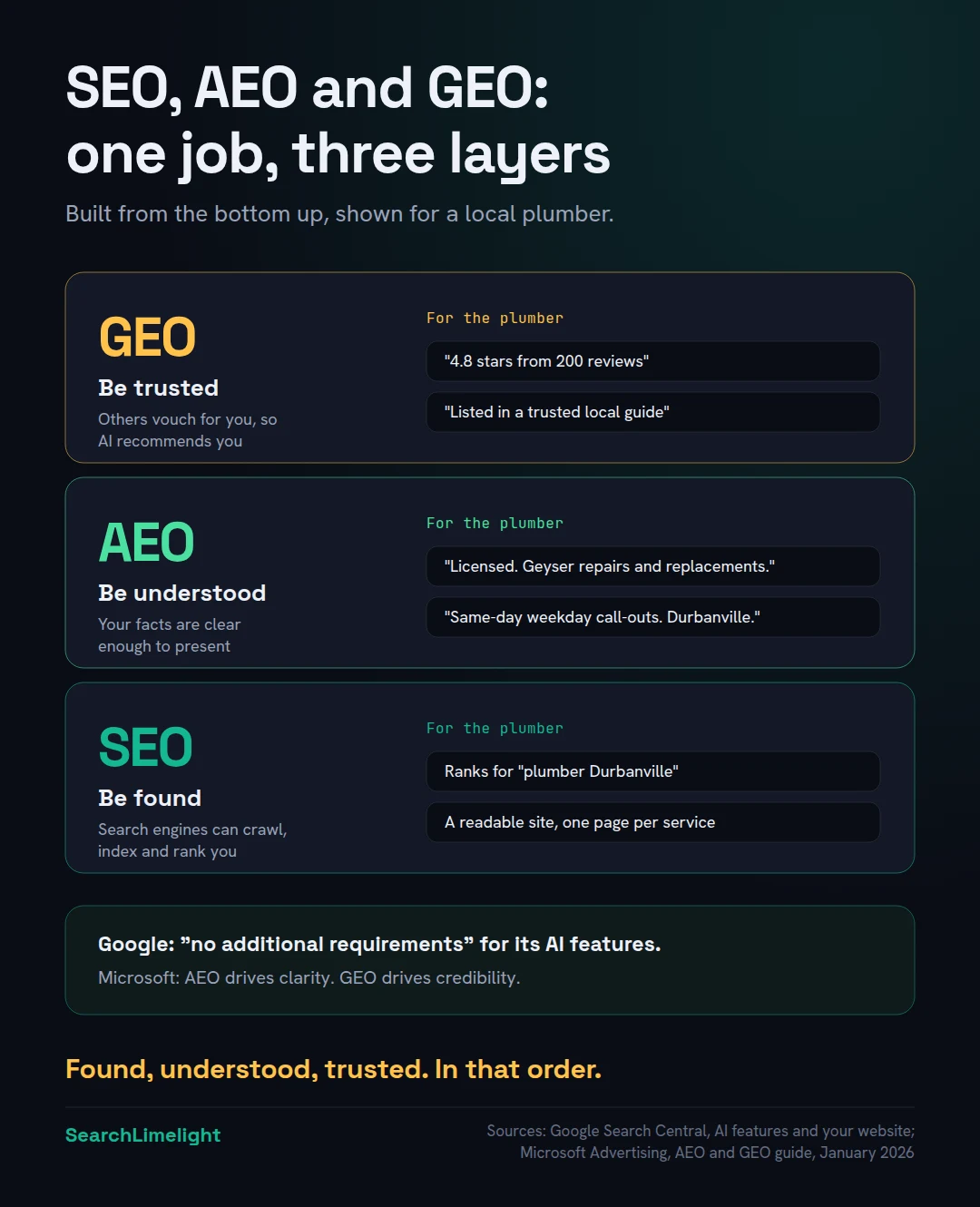
Microsoft illustrates it with a rain jacket. Here’s the same idea for a local plumber:
- SEO gets the page found: ranking for “plumber Durbanville”.
- AEO makes the facts clear: licensed, geyser repairs and replacements, same-day call-outs on weekdays, serving Durbanville and Kraaifontein.
- GEO gives the proof: a 4.8-star rating from 200 reviews, a listing on a trusted local guide, a mention in the community newspaper.
An AI tool needs all three before it can confidently say “try this plumber”. It has to find you, understand exactly what you do and where, and trust that others vouch for you.
5. What does AEO look like in practice?
Answer customer questions directly near the top of each page, keep your business facts clear and identical everywhere, use headings that match real questions, add structured data that matches what’s on the page, and make sure nothing blocks search engines from reading your site.
Here’s what AEO work actually involves for a small business:
- Answer questions directly. Open each section with a short, plain answer, then explain. We cover the method in How to write content AI actually quotes.
- Use real questions as headings. “How much does a geyser replacement cost?” is easier for an answer engine to match than “Our pricing philosophy”.
- State your facts plainly. What you do, where, your hours, your service areas, your price ranges where you can share them. Put them in text, not only in images.
- Keep facts identical everywhere. Your website, Google Business Profile and listings should say the same thing. Answer engines compare sources, and contradictions make them less confident.
- Build a genuine FAQ. Use the questions customers really ask you, on the phone and by email. Not invented ones.
- Add structured data where it fits. Structured data is code that labels your information, like your opening hours or your address, for search engines. Google says it should match what’s visible on the page.
- Don’t block the crawlers. Check that your robots.txt file doesn’t block search engines or the crawlers AI tools use. The 10-minute self-check shows how.
A before and after. Here’s a typical FAQ answer from a dental practice’s website:
“Q: Do you see emergencies? A: At our practice, patient care is always our top priority, and we do our very best to accommodate everyone who needs us.”
An answer engine can’t use that. It doesn’t say yes or no, when, or how. Here’s the AEO version:
“Q: Do you see dental emergencies? A: Yes. We keep same-day emergency slots from Monday to Saturday for pain, swelling and broken teeth. Call 021 000 0000 before 10am to book one.”
Now the question has a direct answer, with specific, checkable facts. If someone asks an AI “is there a dentist near me who sees emergencies on Saturday?”, this is the kind of sentence it can use. (The practice and number are an invented example.)
For online stores, there’s an extra layer. Microsoft’s guide puts a lot of weight on complete, accurate product data, like specifications, prices and stock levels, because AI shopping tools rely on it heavily.
6. Do you need special files, tools or markup for AEO?
Not for Google. It says you don’t need new AI text files or special markup to appear in its AI features. Good structure and clear facts matter far more than any new file. Be sceptical of anyone selling AEO as a technical fix you can install.
You may have heard about files like llms.txt, which some suggest adding to a website to help AI tools. Google’s guidance is clear that you don’t need new machine-readable files, AI text files or markup to appear in AI Overviews or AI Mode.
That doesn’t mean structured data is useless. It still helps search engines understand your pages, and product data matters for AI shopping. But it isn’t a shortcut. The answer engine still needs clear, accurate, trustworthy content to work with.
A good test for any AEO proposal: ask what it changes on the page a customer actually reads. If the answer is “nothing, it’s all behind the scenes”, be wary.
7. Which should a small business focus on: SEO, AEO or GEO?
All three, in order. Get the SEO foundation right so you can be found. Add AEO so your facts are clear and quotable. Then build GEO, meaning reviews, mentions and proof, so AI trusts you. For most local businesses, it’s one plan, not three services.
Here’s how the layers map to a typical local business:
| Layer | What it means for you | Examples |
|---|---|---|
| SEO: be found | Search engines can crawl, index and rank your site | A readable website, service pages, no blocked pages |
| AEO: be understood | Your facts are clear and easy to present | Direct answers, clear services and areas, accurate hours |
| GEO: be trusted | Other sources back you up | Reviews, listings, local mentions, “best of” guides |
If someone offers you three separate services for these, ask which parts overlap. In most cases, one well-planned approach covers all three. We compare the first and third in more detail in SEO vs GEO: do you need both?
What to do this week
- Ask ChatGPT and Google: “What are the opening hours and services of [your business] in [your area]?” Note anything wrong.
- Fix the facts at the source: your website and Google Business Profile first.
- Rewrite one service page so it opens with a direct answer to the main question customers ask.
- Collect ten real customer questions from your phone calls and emails, and answer them on your site.
- Check your robots.txt file doesn’t block search engines or AI crawlers.
- Ask your provider how their AEO or GEO work differs from the SEO they already do.
Frequently asked questions
What does AEO stand for?
AEO stands for answer engine optimisation. It’s the work of making your content and business information easy for search engines, AI tools and voice assistants to understand and present as a direct answer. Microsoft also uses AEO to mean agentic engine optimisation, for AI agents that complete tasks like shopping.
Will AEO replace SEO?
No. Google says there are no additional requirements to appear in its AI Overviews or AI Mode beyond being indexed and eligible to show in search. SEO is the foundation that AEO builds on. If search engines can’t find and read your pages, answer engines that rely on them can’t either.
Is AEO the same as GEO?
They overlap so much that many people use the terms interchangeably, and there’s no agreed definition. A useful distinction from Microsoft’s 2026 guide: AEO focuses on clarity, so AI can present your facts accurately. GEO focuses on credibility, so AI trusts you enough to recommend you.
What is an answer engine?
An answer engine is any tool that answers a question directly rather than giving you a list of links. Examples include Google’s AI Overviews and AI Mode, ChatGPT, Perplexity, Microsoft Copilot and voice assistants like Siri and Alexa.
Do I need llms.txt or special markup for AEO?
Not for Google. Its guidance says you don’t need new machine-readable files, AI text files or markup to appear in its AI features. Structured data can still help search engines understand your pages, but clear, accurate content matters far more than any new file.
Do I need a separate AEO agency?
Usually not. AEO overlaps heavily with good SEO and with GEO. For most small businesses, one provider covering all three layers is simpler and avoids paying twice for the same work. Ask any provider which parts of their AEO work are genuinely new.
How do I know if AEO is working?
Ask answer engines the questions your customers ask, and check whether they present your business correctly: the right services, areas, hours and details. Track it monthly. How to check your AI visibility covers free methods and tools.
Want to know how answer engines describe you?
Most businesses find at least one wrong fact in what AI says about them, and it’s usually easy to fix once you know. Our free AI Visibility audit checks what answer engines say about you, where it comes from, and what to fix first.
Book a free discovery call and choose the audit that fits: AI Visibility & GEO, SEO, or Local Business SEO. No pitch until you’ve seen the gap.
Related reading
- What is GEO? A plain-English guide for business owners
- SEO vs GEO: do you need both?
- How to write content AI actually quotes
About the author
Bantu Nonyukela is the founder of SearchLimelight. He has spent ten years in SEO, after starting out as a front-end developer, and is a Toptal-verified SEO expert. From Cape Town, he helps small and medium businesses in South Africa, the US, the UK and Australia get found in search and named by AI. Connect on LinkedIn
Sources
- Google Search Central, “AI features and your website”: developers.google.com
- Microsoft Advertising, “From Discovery to Influence: A Guide to AEO and GEO,” January 2026: about.ads.microsoft.com
- Search Engine Journal, “A Breakdown of Microsoft’s Guide to AEO & GEO,” January 2026: searchenginejournal.com