Key takeaways
- Local SEO for dentists is the work of showing up when nearby patients search for a dentist, on Google Search, Google Maps, other map apps and AI tools.
- Google has specific rules for dentists. A solo dentist shares one profile with the practice. A practice with several dentists gets its own profile, and each public-facing dentist can have a separate one.
- Reviews matter more in dentistry than almost anywhere else, but replying carelessly can breach patient privacy. One US dental practice paid $23,000 over what it wrote in review replies.
- Google holds health content to a higher standard, so treatment pages should be accurate, specific and clearly backed by a qualified dentist.
“We’ve got a great team and happy patients. Why does the practice down the road always come up first on Google?”
Usually the answer isn’t the quality of the dentistry. It’s that the other practice has a complete Google Business Profile, more recent reviews and a website that clearly says what they treat and where.
This guide walks through local SEO for dental practices in plain English: how to set up your Google profiles correctly, including the practitioner rules most practices get wrong, what your website needs, how to handle reviews without breaching patient privacy, and how to show up when patients ask AI for a dentist.
1. What is local SEO for dentists, and why does it matter?
Local SEO for dentists is the work of making your practice show up when nearby patients search for dental care, in the map results, the normal results and AI answers. It matters because patients choose a dentist close to home, compare reviews before booking, and increasingly start with Google Maps or an AI tool.
Most dental searches are local. Someone with a cracked tooth searches “emergency dentist near me”, and Google shows a map with three practices.
Local SEO (search engine optimisation) is how you earn a place there. It rests on three things Google says it uses to rank local results: relevance, distance and prominence. Relevance is how well your profile matches the search. Distance is how close you are. Prominence is how well known and well reviewed you are.
The patient’s first impression is now online. In BrightLocal’s 2026 survey of US consumers, 97% read reviews for local businesses, and 45% had used ChatGPT or another AI tool to find local business recommendations, up from 6% a year earlier.
You’ll also see this called dental SEO. It covers the same ground, plus the wider work on your website.
2. How should a dental practice set up its Google Business Profile?
Claim one profile per location, use your real practice name, choose the most specific category, list a phone number the practice answers, and keep hours accurate. Add treatments as services, real photos of the practice and team, and a plain description without links or promotional prices.
Your Google Business Profile is the listing that shows in Maps and the map results. Google’s guidelines for representing your business set the rules.
Name. Use your practice name as it appears on your signage. Adding “Best Dentist Cape Town” or “Implants and Invisalign” to the name breaks the guidelines, and Google says extra information in the name could result in suspension.
Category. Google asks you to choose the fewest, most specific categories that describe what your business is. “Dentist” is right for a general practice. Add “Orthodontist” or “Pediatric dentist” only if the practice genuinely is one, not because you offer a single orthodontic treatment.
One profile per location. Each branch gets its own profile, with its own phone number and page on your website.
Phone. Google asks for a number under the practice’s direct control, and doesn’t allow numbers that redirect patients elsewhere.
Services. List your treatments, such as check-ups, cleaning, fillings, crowns, implants, whitening and emergency appointments. Use the words patients use.
Description. Say who you are, what you treat and who you serve. Google doesn’t allow links or promotional prices in the description, so leave out “Whitening special this month!”
Photos. Show the building, reception, a treatment room and your team. Never photograph patients without written consent.
3. Should each dentist have their own Google Business Profile?
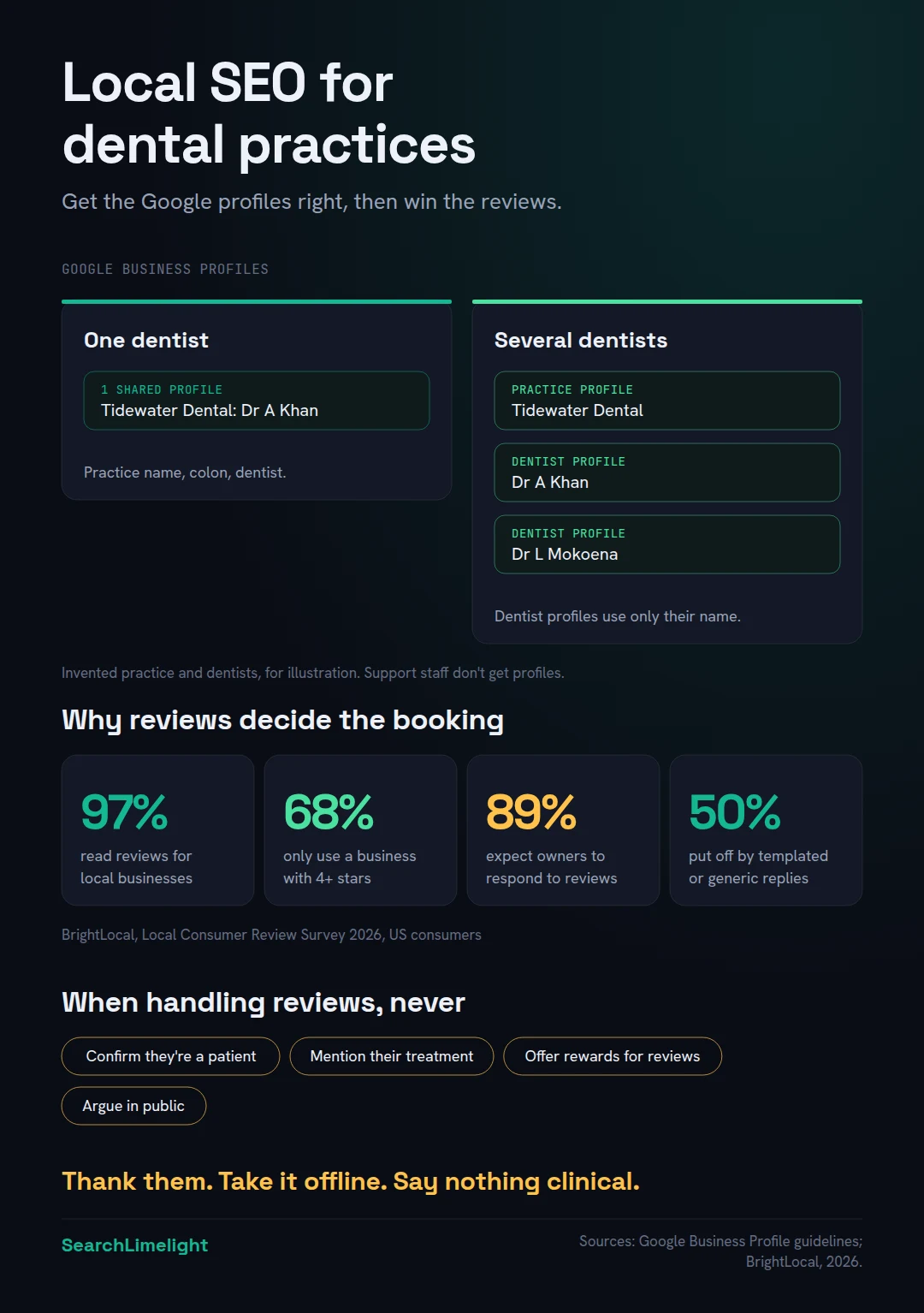
It depends on how many dentists work there. A solo dentist shares one profile with the practice, named “Practice: Dentist”. With several dentists, the practice gets one profile and each public-facing dentist may have their own, using only their name. Hygienists and support staff don’t get profiles.
This is the rule most practices get wrong, and it’s written out plainly in Google’s guidelines. Google names dentists as an example of an individual practitioner: a public-facing professional with their own patients.
If you’re the only dentist at the practice, Google recommends one shared profile, named in the format “Practice name: Dentist name”. For an invented example, “Tidewater Dental: Dr Ayesha Khan”. You don’t need two profiles competing with each other.
If several dentists work at the practice, Google’s guidelines say:
- the practice should have its own profile, separate from any dentist
- each dentist can have their own profile if they’re public facing and can be contacted at that location during stated hours
- a dentist’s profile should include only their name (a title like Dr is allowed), not the practice name
- a dentist shouldn’t have several profiles for different specialisms
- support staff, like dental assistants and receptionists, shouldn’t have profiles
Should you create them? Practitioner profiles help patients who search for a dentist by name, and they give each dentist a place to collect their own reviews. The trade-off is that reviews get split across several profiles, and the practice has more listings to keep accurate. For most practices, I’d start with a strong practice profile and add dentist profiles only for dentists who stay long term and have patients asking for them by name.
Plan for departures. Agree who owns each dentist’s profile, and what happens to it if they leave, before you create it.
4. What does a dental website need to rank locally?
A page for each main treatment, a page for each location, contact details that match your Google profile, and proof that qualified dentists stand behind the content. Google gives extra weight to trust for health topics, so accurate, specific pages beat long generic ones.
A page per main treatment. Implants, braces, whitening and emergency care each deserve their own page. Explain what the treatment involves, who it suits, how long it takes and what happens at the first visit.
A page per location. With more than one branch, each one needs its own page with the address, phone number, opening hours, parking and a map. Our guide to local landing pages explains how to do this properly.
Don’t spin up pages for every suburb. Near-identical pages targeting towns you don’t have a practice in are what Google calls doorway abuse, and long lists of suburbs in a block of text count as keyword stuffing. Mention the areas you serve naturally instead.
Show who is behind the advice. Google explains that its systems give more weight to content with strong experience, expertise, authoritativeness and trust for topics that could significantly affect people’s health. Google calls these “Your Money or Your Life” topics. For a dental site, that means:
- a team page with each dentist’s qualifications and registration
- treatment pages written or checked by a dentist, with their name on them
- clear, honest information about risks and recovery
- no promises of results
Add structured data. Structured data (also called schema markup) is code that tells search engines your practice’s name, address, hours and type. Google recommends using the most specific type, and “Dentist” is one of them. Don’t mark up your own testimonials as star ratings. Google recommends review markup only for sites that collect reviews about other businesses. Our schema markup guide covers the rest.
Check your professional rules. Most countries have rules on how dentists can advertise, including testimonials, before and after photos and claims about results. Check your regulator’s current advertising guidance before publishing.
5. How should dentists handle reviews without breaking patient privacy?
Ask every patient after a good visit, reply to every review, and keep replies general. Never confirm that the reviewer is a patient, never mention their treatment, and never offer rewards for reviews. A thank you and an invitation to call the practice is enough, even when the review is unfair.
Reviews shape which dentist a patient picks. In BrightLocal’s 2026 survey:
- 68% of consumers will only use a business with 4 or more stars
- 47% won’t use a business with fewer than 20 reviews
- 74% only care about reviews from the last three months
- 89% expect business owners to respond to reviews
Ask consistently. In the same survey, 83% of people who were asked to leave a review did so. Ask at the end of the appointment, then send a short text or email with your review link. Make it routine for the front desk.
Never pay for reviews. Google prohibits offering incentives for reviews, including discounts on the next check-up. In the US, the Federal Trade Commission’s rule on fake reviews also allows fines for buying them.
Protect patient privacy in every reply. This is where dental practices get into real trouble. In December 2022, the US Department of Health and Human Services announced that a dental practice, New Vision Dental, paid $23,000 after disclosing patients’ health information in replies to online reviews. The same principle applies under privacy law almost everywhere: a review doesn’t give you permission to discuss someone’s care in public.
A safe reply to a negative review looks like this:
“Thank you for your feedback. We take every concern seriously and would like to understand what happened. Please call our practice manager on [number] so we can talk it through privately.”
It doesn’t confirm they’re a patient, doesn’t mention appointments or treatment, and doesn’t argue. Avoid templates word for word, though. BrightLocal found 50% of consumers are put off by templated or generic replies. Our guide on how to respond to Google reviews has more examples.
6. Which listings and directories matter for a dental practice?
Your Google Business Profile first, then Apple Business and Bing Places, then the health and dental directories patients use in your country, including your insurers’ and professional body’s listings. Every one should show exactly the same practice name, address and phone number.
Map apps beyond Google. Patients on iPhones see Apple Maps by default. Claim your practice in Apple Business, which replaced Apple Business Connect in April 2026, and on Bing Places for Business, which feeds Microsoft’s Copilot.
Health directories. Most markets have directories where patients search for dentists and book appointments. Your professional body’s public register and your medical insurers’ provider lists count too. Look at which directories appear on page one when you search “dentist” plus your suburb, and make sure you’re on them.
Consistency. These listings are called citations. When your details differ between them, Google and AI tools have to guess which is right. Our guide to local SEO citations shows how to find and fix them.
If you’re weighing up whether to do this yourself or pay someone, our guide to local SEO pricing explains what the work usually involves.
7. How do dental practices show up when patients ask AI?
AI tools build their answers from search results, map listings, reviews and websites. So the same work that helps you rank on Google helps you get named by AI: a complete profile, steady reviews, clear treatment pages and consistent listings. Check what AI tools say about your practice every few months.
Patients now ask ChatGPT or Google’s AI Mode things like “Which dentist in Sea Point is good with nervous patients?” The AI searches and names a few practices.
Google says its AI features are rooted in the same core ranking systems as search, and names the Business Profile as a source for local details. There’s no separate trick for AI. OpenAI says ChatGPT search uses the searcher’s approximate location for local questions, and your website needs to allow its search crawler, OAI-SearchBot.
Three things make a practice easier for AI to recommend:
- Specific, checkable details. “Sedation available for anxious patients” answers a real question. “Gentle, caring dentistry” doesn’t.
- Reviews that mention what you’re good at. Patients often say what went well.
- Consistent facts everywhere. AI tools compare sources, and conflicting details make you a riskier recommendation.
Test it yourself. Ask two or three AI tools the questions your patients ask, and note whether you’re named and what’s said. Our AI visibility check walks you through it, and What is GEO? explains the bigger picture.
What to do this week
- Search “dentist” plus your suburb on your phone and note which three practices appear in the map.
- Fix your Google profile name so it matches your signage exactly.
- Check your categories and remove any that don’t describe what the practice is.
- Decide on practitioner profiles using the rules in section 3.
- Set up a review request that goes to every patient after a good visit.
- Rewrite your reply template so it never confirms someone is a patient.
- Claim Apple Business and Bing Places if you haven’t already.
Frequently asked questions
How long does local SEO take for a dental practice?
Fixes to your Google profile can show within weeks. Building reviews, treatment pages and consistent listings usually takes several months to show steady results. Google itself says changes can take anywhere from hours to months to be reflected, so judge progress over a few months, not a few days.
What’s the difference between dental SEO and local SEO for dentists?
Local SEO focuses on showing up in the map results and local searches: your Google profile, reviews and listings. Dental SEO is often used more broadly, including your website’s treatment pages and content. In practice, a dental practice needs both, and most of the work overlaps.
Should our dentists have their own Google profiles?
If you have several public-facing dentists, Google allows each one a profile alongside the practice’s profile. If you’re a solo dentist, Google recommends one shared profile named “Practice: Dentist”. Hygienists and support staff shouldn’t have profiles.
Can we offer patients a discount for leaving a review?
No. Google prohibits incentives for reviews, and in the US, the FTC can fine businesses that buy fake reviews. Ask every patient instead, and make it easy with a direct link.
How should we reply to a negative review from a patient?
Keep it general and move the conversation offline. Thank them, say you’d like to understand what happened, and give a number to call. Never confirm they’re a patient or mention any treatment, even if the review is unfair.
Do we need a separate page for every suburb we serve?
No. Create a page for each location you actually have. Pages for suburbs where you have no practice, especially near-identical ones, risk breaking Google’s spam policies. Mention the areas you serve naturally on your location pages.
Does AI recommend dentists?
Yes. Tools like ChatGPT and Google’s AI Mode answer questions like “best dentist near me” by naming practices. They draw on map listings, reviews and websites, so a complete profile and consistent details help you appear.
Want to know where your practice stands?
Most practices have never seen their profile, website and reviews the way a new patient does. Our free audit checks your Google profile, listings, website and AI visibility, and shows you what’s holding you back.
Book a free discovery call and choose the audit that fits: AI Visibility & GEO, SEO, or Local Business SEO. No pitch until you’ve seen the gap.
Related reading
- 12 Google Business Profile mistakes that quietly cost you calls
- Local landing pages: how to build location pages that rank
- Local SEO checklist: 40 checks for small businesses
About the author
Bantu Nonyukela is the founder of SearchLimelight. He has spent ten years in SEO, after starting out as a front-end developer, and is a Toptal-verified SEO expert. He helps small and medium businesses in the United States, Australia, the United Kingdom and South Africa get found in search and named by AI. Connect on LinkedIn
Sources
- Google Business Profile Help, Guidelines for representing your business on Google: support.google.com
- Google Business Profile Help, Improve your local ranking on Google: support.google.com
- Google Business Profile Help, Tips to get more reviews: support.google.com
- Google Search Central, Creating helpful, reliable, people-first content: developers.google.com
- Google Search Central, Spam policies: developers.google.com
- Google Search Central, LocalBusiness structured data: developers.google.com
- Google Search Central, Optimising for generative AI: developers.google.com
- OpenAI Help, Searching the web with ChatGPT: help.openai.com
- BrightLocal, Local Consumer Review Survey 2026: brightlocal.com
- US Department of Health and Human Services, New Vision Dental settlement, December 2022: hhs.gov
- US Federal Trade Commission, Rule on the Use of Consumer Reviews and Testimonials: ftc.gov