Key takeaways
- The goal is not to rank first. It is to make AI systems understand who you are, what you sell, where you work and why you are relevant, because an engine cannot recommend a business it cannot confidently identify.
- Most of the work is not on your website. Your own pages tell an engine what you claim. Other sites tell it whether to believe you.
- Being specific beats being big. “Marketing company” is a category. “Marketing for independent restaurants” is a reason to be named.
- Do the testing first, not last. If you have not recorded what the engines say about you today, you have no way of knowing whether anything you change afterwards worked.
“How do I get my business to show up in AI?”
I get asked this most weeks now, usually by someone who has just typed their own trade into ChatGPT, watched it recommend four competitors, and felt slightly sick about it.
The honest answer is that it is not one thing, and anyone selling you one thing is selling you something. But it is also not mysterious. The engines are trying to answer a question well. They need to work out which businesses are relevant, and they need enough confidence to put a name in front of a person who is about to spend money. Everything below is in service of those two problems.
This guide covers the seven things I would fix, in the order I would fix them, what each one actually involves, and how to tell whether it worked.
First, the thing most advice gets wrong
The goal is not to rank number one. It is to be understood. Search ranking is a list. An AI answer is a recommendation, and a recommendation requires the engine to have a view about you: what you do, who you serve, where, and why you are worth naming ahead of the other options. A business the engine cannot confidently describe does not get named, however good its website is.
That changes what the work looks like. Ranking rewards being the best page for a query. Being named rewards being the clearest, most corroborated entity on a topic. Those overlap a lot, which is why good SEO is not wasted here, but they are not the same job.
It also changes who has a chance. You do not need to outrank a national directory to be named in an answer about your city or your speciality. You need to be the most obviously relevant business for that particular question, and to have enough independent evidence behind you that naming you is a safe bet.
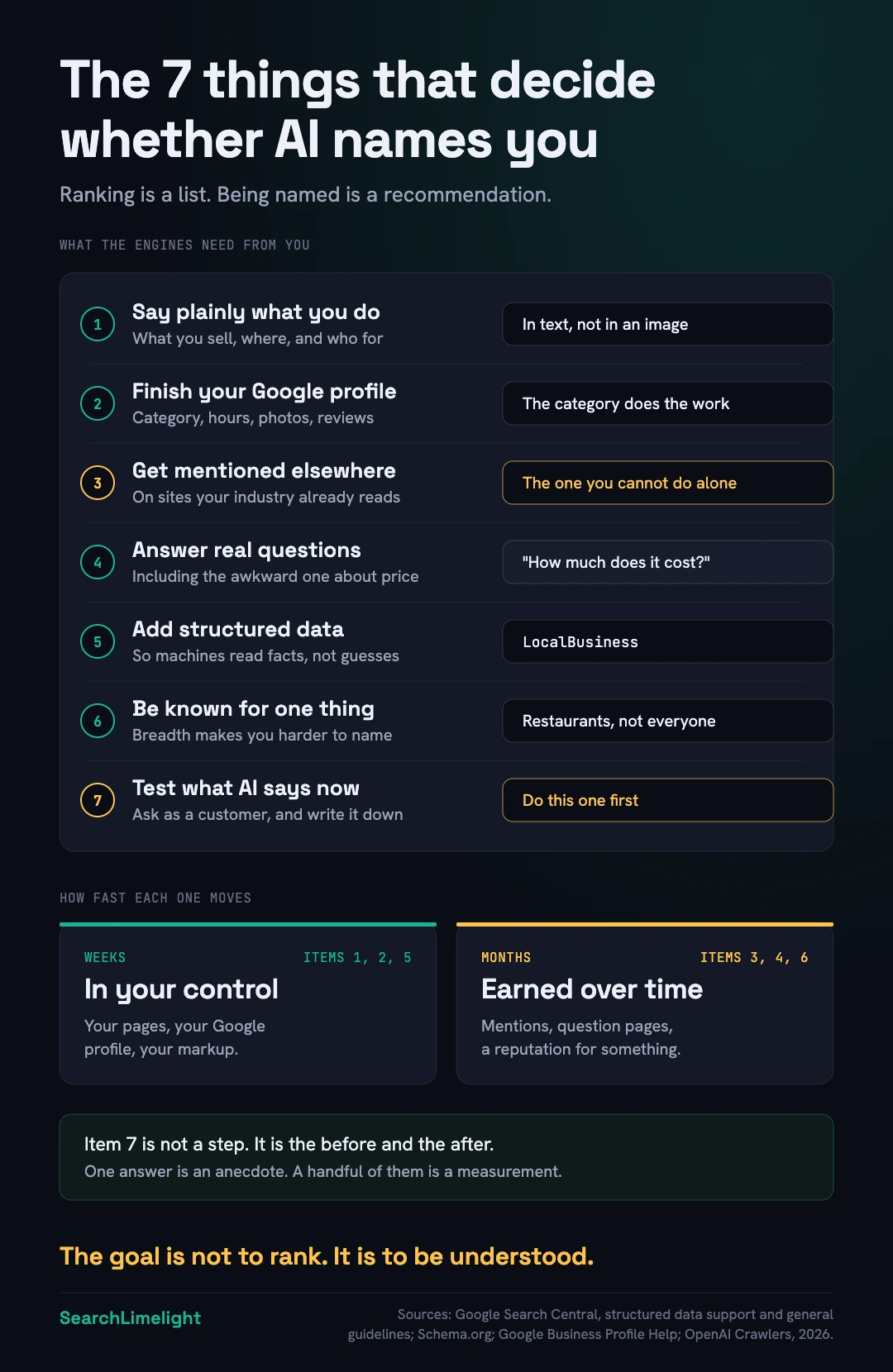
1. Make your business easy for AI to understand
Say plainly what you sell, where you work and who you serve, in text, on pages a machine can read. This is the least glamorous item on the list and the one that blocks everything else. An engine that cannot tell what you do will not name you, no matter how much you spend on the rest.
Your site should state, without a reader having to infer any of it:
- Your business name, spelled the same way everywhere
- The exact services or products you sell, named the way customers name them
- The locations or areas you actually serve
- Who you serve, if you serve a particular kind of customer
- Your areas of expertise
- Prices, or at minimum how you price, where that is reasonable in your industry
- How to contact you
- Who is behind the business
The failure mode is not missing information. It is information hidden inside marketing language. “We create transformative brand experiences” is not a service. “We build and run email marketing for subscription businesses” is. If a sentence would survive being read out to a stranger who then had to explain your business back to you, it is doing its job.
Two practical notes. Put it in text, not in an image or a video, because neither is reliably read. And watch for detail drifting apart across your site, your Google listing, your social profiles and the directories you appear in. An engine comparing four versions of your opening hours has a confidence problem, and it will often solve it by naming a business it is more sure about.
2. Build a strong Google presence
For a local business, your Google Business Profile is the single highest-leverage thing on this list, because it is a structured, verified description of you that engines can trust without inferring anything. It is also the thing most often left half-finished after the first week.
Keep these accurate and current: your primary category, the services you list, your address or service area, opening hours including exceptions, photos, and the business description. Then keep reviews coming in steadily, because a profile with recent reviews reads as an active business and one with nothing since last year does not.
The category field does more work than people expect. It is a strong signal about what you are, and businesses regularly sit in a category that made sense when they opened and does not describe them now. The common Google Business Profile mistakes are worth a read if you have not revisited yours.
This matters beyond Google. Engines lean on established sources when they need facts they can rely on, and a verified business listing is exactly that kind of source.
3. Get mentioned by other websites
This is the one that moves the needle most, and the one businesses skip, because it is the only item you cannot complete by yourself. AI systems do not only read your website. They read what other people have written about you, and independent mentions are what turn your claims into established facts.
Where those mentions come from depends on your industry, but the useful ones tend to be:
- Local and trade publications
- Industry directories that actually cover your sector
- Professional associations and accrediting bodies
- News coverage and interviews
- Podcasts
- Supplier and partner websites
- Review sites your customers already use
The emphasis is on relevant and genuine. A hundred low-quality links from sites with no connection to your industry do not make you more credible to a system trying to decide whether to recommend you, and they can actively hurt you in classic search. One mention in a publication your industry reads is worth more than all of them.
If you want a place to start: the sites where your competitors are already mentioned. That list is finite, it is discoverable, and it tells you exactly which sources the engines are likely to be reading about your industry. Citations and consistent listings are the floor of this, not the ceiling.
4. Create pages answering the questions customers actually ask
Engines answer questions, so give them pages that answer questions. A service page called “Electrical Services” tells a system what category you are in. A page that answers what a rewire costs and what it involves gives it something to actually quote.
If you are an electrician, do not only have:
Emergency Callouts
Also have:
- How much does an emergency electrician call-out cost?
- What counts as an electrical emergency, and what can wait until morning?
- How long does it take to replace a consumer unit?
- What should you check before calling an electrician out?
Those pages associate specific, useful information with your business. They also do something less obvious: they answer the questions people ask right before they buy, which means the traffic they attract is closer to spending than anything a generic service page brings in.
Write them to be quoted. Short, factual, self-contained passages get lifted into answers far more readily than long paragraphs that need three sentences of context. I wrote more about structuring content so AI can quote it, and it is largely a matter of answering the question in the first sentence rather than the fourth.
The awkward one is price. Most businesses do not want to publish it. But “how much does X cost” is one of the most asked questions in almost every industry, and if you will not answer it, something else will answer it for you, usually with a number you did not choose. A price range with an explanation of what moves it is better than silence.
5. Use structured data
Structured data is the difference between a machine reading your page and a machine parsing your page. It is a block of code that states your facts in a format built for software: your name, address, hours, services, prices, reviews, the questions and answers on the page.
The relevant types for most businesses are `LocalBusiness` or a more specific subtype of it, `Organization`, `Service`, `Product` and `FAQPage`. Google publishes the full list of what it supports, and Schema.org is the underlying vocabulary.
Two warnings, because this is where I most often find damage on audits. First, the markup must match what is visible on the page. Marking up prices or reviews that a visitor cannot see is a policy violation and a good way to lose rich results entirely. Second, plugin-generated schema is frequently wrong or duplicated, with three conflicting descriptions of the same business on one page. If you already have structured data, it is worth validating what is actually being output rather than assuming.
This is the item where it is genuinely reasonable to get help. It is also the one with the clearest pass or fail: the markup is valid and accurate, or it is not.
6. Become known for something specific
Breadth makes you harder to recommend, not easier. “Marketing company” describes thousands of businesses and gives an engine no reason to prefer you. “Marketing for independent restaurants” describes a much smaller set, and when someone asks about marketing for their restaurant, that set is the one being drawn from.
What you want, over time, is for a system to be able to make an association like this:
[Your business] → restaurants → independent operators → marketing → SEO and social
That association does not come from a tagline. It comes from consistently publishing about that subject and consistently being mentioned in connection with it. Which is to say it comes from items 3 and 4 above, pointed in the same direction for long enough to add up.
The fear here is always the same: that narrowing means turning work away. In practice it usually means being the obvious choice for a smaller group instead of a forgettable option for a large one. You can still take the other work. You just will not be pitching for it from a cold start.
7. Test what AI actually says about you
Do this first, not last. It is the step nearly everyone skips, and skipping it makes everything above unmeasurable. If you do not know what the engines say about you today, you have no way of knowing in three months whether your work changed anything or the engines simply changed.
Ask several systems the questions your customers would actually ask:
- Who are the best [type of business] in [your area]?
- What companies provide [specific service] in [your area]?
- What should I look for when choosing a [type of business]?
- Which [type of business] specialises in [your niche]?
- What are the alternatives to [competitor]?
Then record, for each answer:
- Were you mentioned at all?
- If you were, how were you described, and was any of it wrong?
- Which competitors appeared, and in what order?
- Which websites did the engine cite?
That fourth one is the most useful thing on this page. The cited sources are a list of the places currently shaping what AI says about your industry. That list is your target list for item 3, handed to you.
Two things to watch. Answers vary between runs, so one result is an anecdote and a handful is a measurement. And ask as a customer would, not as yourself: “who is the best electrician near me” is a real question, “is [your business name] good” is not, and the second one will flatter you.
There is a longer self-check here if you want to work through it properly, and a shorter version on checking AI visibility. If you would rather not do it by hand, the free check on this site reads your website, writes the questions your customers would ask, puts them to the engines and shows you every answer with the sources cited. It takes about two minutes and does not need your email address to show you the questions.
What to actually do first
Seven things is a lot, and doing them in the wrong order wastes months. If I had to sequence it:
- Test first. An hour, or two minutes with a tool. You need the before.
- Fix your own pages. Items 1 and 5. These are entirely within your control and nothing else works properly without them.
- Finish your Google Business Profile. Item 2. High leverage, low effort, and most profiles are half-done.
- Start the question pages. Item 4. One a week beats twelve in a burst and then nothing.
- Work on mentions. Item 3. Slowest, highest value, and the cited-sources list from step 1 tells you where to aim.
- Let the specificity accumulate. Item 6 is the result of doing 3 and 4 consistently, not a separate task.
- Test again. Same questions, same engines, and compare.
The honest timeline: schema, profile and listing corrections can shift things within weeks. Building durable presence in the sources engines trust takes months. Anyone promising otherwise is describing a different business than yours.
Common questions
Does any of this work if I have a small website? Yes, and often better than you would expect. Being named in an answer about a specific service in a specific place does not require you to outrank a national site. It requires you to be clearly relevant and independently corroborated for that narrow thing.
Do I need to be in ChatGPT specifically? You need to be in whichever systems your customers use, and that varies by market and industry. The underlying work is largely the same across them, because they are all solving the same identification problem. Where ChatGPT gets its information explains why the same fixes tend to move several engines at once.
Is this different from SEO? It overlaps heavily and is not identical. The structured data, consistency and authority work serve both. What is different is the emphasis on being a clearly defined entity rather than a well-ranking page, and on measuring named mentions rather than positions.
What if the AI says something wrong about my business? Find the source. Wrong information almost always traces back to an outdated listing, an old page of yours, or a third-party profile you forgot existed. Fix it at source, then re-test. Arguing with the output does nothing; correcting what it reads does.
Where to start
If you take one thing from this: record what the engines say about you before you change anything. Everything else on this list is a reasonable thing to do. Only that one tells you whether doing it worked.
Run the free check to see your current answers, the competitors being named instead of you, and which sources the engines are citing about your industry. Or book a call and we can go through where you stand and what would move first.
Read next
- Where does ChatGPT get its information? A guide for business owners
- Is your business showing up in ChatGPT? A 10-minute self-check
- What is GEO? A plain-English guide for business owners
About the author
Bantu Nonyukela is the founder of SearchLimelight. He has spent ten years in SEO, after starting out as a front-end developer, and is a Toptal-verified SEO expert. He helps small and medium businesses in the United States, Australia, the United Kingdom and South Africa get found in search and named by AI. Connect on LinkedIn
Sources
- Google Search Central, “Structured data markup that Google Search supports”: developers.google.com
- Google Search Central, “Structured data general guidelines”: developers.google.com
- Schema.org, “LocalBusiness”: schema.org
- Google Business Profile Help, “Edit your Business Profile”: support.google.com
- OpenAI, “Overview of OpenAI Crawlers”: developers.openai.com