Key takeaways
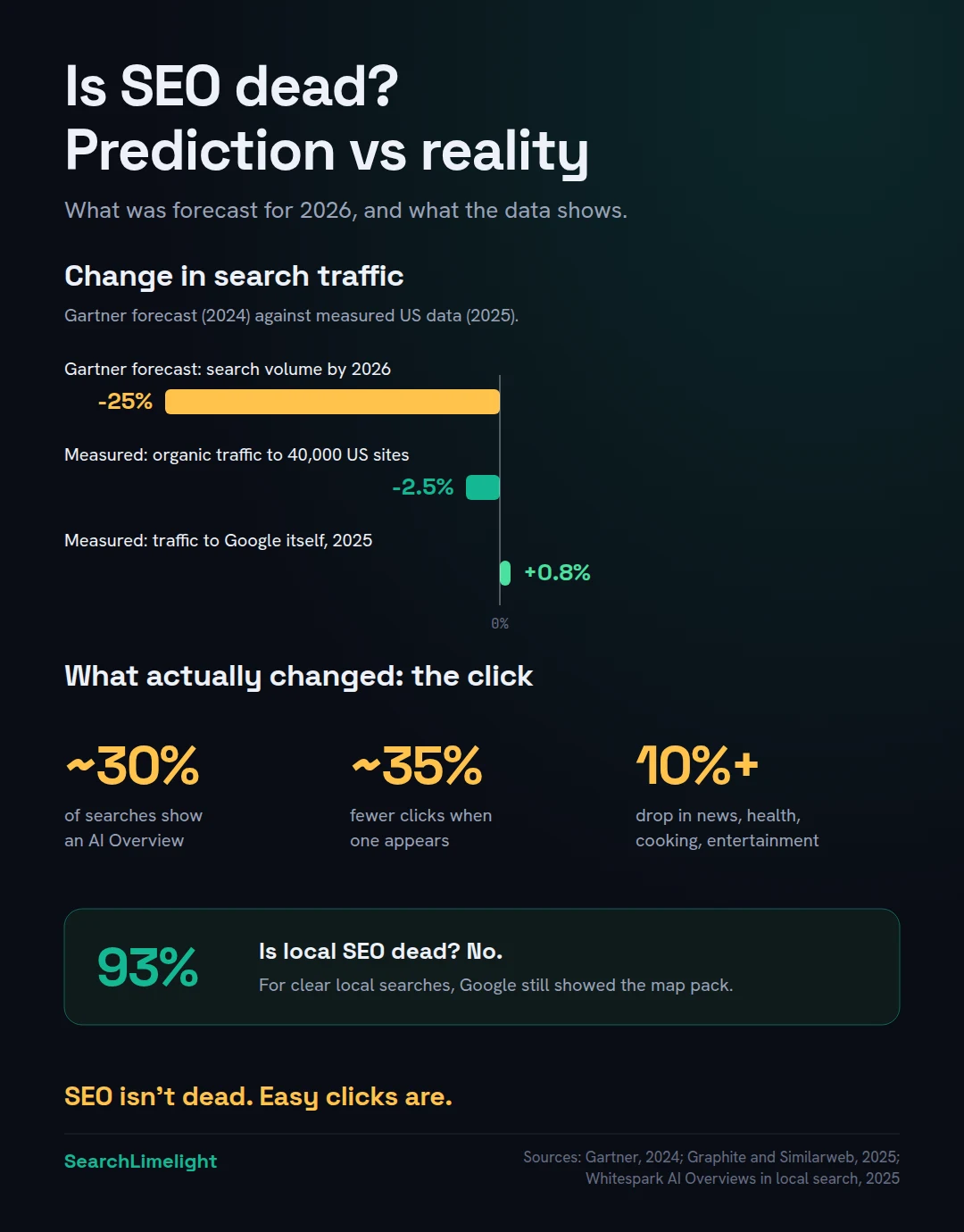
- No. In 2024, Gartner predicted search volume would fall 25% by 2026. Data on 40,000 large US websites shows organic search traffic fell 2.5%.
- What changed is the click. When Google shows an AI Overview, fewer people click through to websites. The losses are concentrated in news, health, cooking and entertainment.
- Local SEO is very much alive. For searches like “plumber near me”, Google showed the map pack 93% of the time and an AI Overview only 15%.
- SEO isn’t dead, but SEO on its own is no longer enough. The businesses doing best now aim to rank and to be named in AI answers.
“Someone at a networking event told me SEO is dead because of ChatGPT. Should I stop paying for it?”
I’ve been hearing “SEO is dead” for my whole career. People still search “is SEO dead 2014” about 150 times a month, according to Ahrefs. The claim comes back every few years, usually after a big Google change, and it’s usually wrong.
This time, though, something real has changed. AI tools are answering questions directly, and fewer searches end with a click. So it’s worth looking at the data properly rather than trusting either the doom merchants or the people selling SEO.
This guide does that. It looks at what was predicted, what actually happened, who’s losing traffic and who isn’t, what it means for local businesses, and what SEO looks like now. By the end, you’ll be able to answer the question for your own business.
1. Is SEO dead in 2026?
No. Search is still where most people look for businesses, and Google still sends far more visitors to websites than any AI tool. Across the largest US websites, organic search traffic fell 2.5% in a year, not 25% or more. What has changed is how many searches end in a click, and that hits some businesses much harder than others.
The best large-scale evidence comes from Graphite, working with Similarweb. They analysed traffic to more than 40,000 of the largest websites in the US. Their findings:
- Organic search traffic fell 2.5% year over year. A real decline, but a small one.
- Traffic to Google itself rose 0.8% in 2025, and traffic to search engines overall rose 0.4%.
- The ten largest websites gained traffic. The losses fell mainly on mid-sized sites.
Google says the same thing. In August 2025, it stated that total organic click volume from Google Search to websites had been relatively stable year over year.
And AI tools aren’t close to replacing search as a source of visitors. An Ahrefs analysis found Google sends around 190 times more traffic to websites than ChatGPT does.
So SEO isn’t dead. But “not dead” isn’t the same as “unchanged”.
2. Why do people keep saying SEO is dead?
Because every major change to Google makes some tactics stop working, and the people who relied on those tactics declare the whole field dead. The latest wave was fuelled by a 2024 Gartner prediction that search volume would fall 25% by 2026. That deadline has now arrived.
In February 2024, the research firm Gartner predicted that traditional search engine volume would drop 25% by 2026, as AI chatbots took over. It became one of the most quoted numbers in marketing, often as a reason to panic.
It was a reasonable prediction to make. It just hasn’t happened at that scale. Graphite’s data shows a 2.5% fall in organic search traffic, and Google’s own traffic went up.
Why did the headline go wrong? Mostly because people didn’t stop using Google. They started using AI tools as well. Google also changed, adding AI Overviews and AI Mode, so many people now get AI answers without leaving Google at all.
3. What has actually changed?
The click has changed, not the search. When Google shows an AI Overview, far fewer people click through to websites. AI Overviews now appear on a large share of searches, especially questions. For businesses that relied on answering simple questions, that’s a real loss.
Here’s what the evidence shows:
- AI Overviews reduce clicks. Graphite found they appear on roughly 30% of searches and reduce click-through rates by about 35% when they do. An Ahrefs study found the top result got 58% fewer clicks when an AI Overview was present.
- People rarely click links inside AI summaries. Pew Research Center found users clicked a link in the AI summary on just 1% of visits where one appeared.
- Some industries are hit much harder. In Graphite’s data, news, health, cooking and entertainment sites all saw drops of more than 10%.
- Ads are taking more space. Graphite also notes that Google is shifting more clicks toward ads and away from organic results.
In plain terms: if your website earned traffic by answering simple questions, like “how many grams in a cup” or “what is a mortgage”, that traffic is under real pressure. If your website helps people find, compare and choose a business, much less has changed.
4. Who’s losing traffic, and who isn’t?
Publishers and sites built on simple informational content are losing the most. Businesses whose customers search to find, compare or buy something are far less affected. Local businesses, where people need a nearby service, are among the least affected of all.
A simple way to judge your own risk:
| Your website mostly… | Risk from AI answers | Why |
|---|---|---|
| Answers general questions to earn ad revenue | High | AI can give the answer without a click |
| Publishes news or recipes | High | These categories saw the biggest drops |
| Explains your services and helps customers choose | Medium | AI summarises, but customers still need to pick someone |
| Sells products online | Lower | Buyers need to visit a site to buy |
| Serves customers nearby | Lower | The map pack still dominates local searches |
The AI answer can tell someone what a geyser is. It can’t come and replace one. That’s the difference.
5. Is local SEO dead?
No. For searches where someone wants a local business, Google still shows the map pack almost every time and AI Overviews rarely. AI is changing how customers research before they search, which is why local businesses now need to think about AI answers too.
In 2025, Whitespark ran 540 manual searches across six local industries. For clear local searches, like “plumber near me”, the map pack appeared 93% of the time and an AI Overview only 15%. For research questions, like “how long does an eye exam take”, it flipped: an AI Overview appeared 92% of the time.
So the moment a customer is ready to call someone, the map is still where the decision happens. How “near me” search really works in 2026 explains what decides who appears there.
But the research stage has moved. In BrightLocal’s 2026 survey, 45% of US consumers had used an AI tool to find local business recommendations. If AI leaves you out while the customer is researching, you may not be on their list by the time they search.
6. What does SEO look like now?
SEO now has two jobs: rank in search results, and be named or cited in AI answers. That means less generic content, more original and specific content, a stronger reputation across the web, and measuring visibility as well as clicks.
Here’s how the work has shifted:
| Less of this | More of this |
|---|---|
| Generic articles that repeat what everyone says | Original content with your own knowledge, prices and examples |
| Chasing clicks on simple questions | Pages that help customers compare and choose |
| Links as the main reputation signal | Mentions, reviews and listings across trusted sites |
| Measuring only rankings and traffic | Also measuring impressions and how AI describes you |
| Long introductions before the answer | Direct answers at the top of each section |
The foundations haven’t changed. A website search engines can read, accurate business details and genuinely useful content still matter, and they’re also what AI tools draw on. That’s why most businesses need SEO and GEO together, not one instead of the other. SEO vs GEO: do you need both? explains how they fit.
For the writing side, How to write content AI actually quotes shows how to make pages that work for both.
7. Is SEO still worth it for a small business?
For most small businesses, yes. Search still brings in more customers than any AI tool, local searches still lead to the map pack, and SEO groundwork feeds AI answers. It’s worth it if you target searches where customers are choosing a business, and measure the right things.
SEO is worth it when:
- Your customers search before they buy. Most do.
- You target decision searches, like “emergency electrician Bellville” or “accountant for small business Sydney”, not trivia.
- You measure calls, enquiries and visibility, not just traffic.
- You’re prepared to give it time. Google’s own estimate is four months to a year. How long does SEO take to work? covers what’s realistic.
It’s harder to justify when your business relied on traffic from simple informational content with no clear path to a sale. That model is under real pressure, and it’s worth rethinking.
8. How can you tell if AI is affecting your own traffic?
Compare impressions and clicks in Google Search Console over the last 16 months. If impressions are steady or rising but clicks are falling on certain pages, AI answers are likely taking those clicks. Then check whether calls and enquiries have actually dropped, because that’s what matters.
The headlines are about the web as a whole. Your business might be doing better or worse than average. Here’s how to find out in about 30 minutes:
- Open Google Search Console and go to the Performance report. Set the date range to the last 16 months, so you can compare this year with last year.
- Look at impressions and clicks together. Impressions are how often you appear. Clicks are how often people visit. If impressions hold steady while clicks fall, people are seeing you but not clicking, which is the pattern AI answers create.
- Switch to the Pages tab. Sort by the biggest drop in clicks. Note which pages lost the most.
- Search the main query for each of those pages. Is there an AI Overview? If so, does it answer the question fully? If it does, that page’s clicks are at risk.
- Compare with your enquiries. Check calls, forms, bookings and sales from search over the same period. If enquiries are steady while clicks fell, you’ve mostly lost visits that weren’t going to become customers anyway.
- Check AI referrals. In Google Analytics 4, look for visits from chatgpt.com, perplexity.ai and gemini.google.com. They’re usually small, but a rising trend is a good sign you’re being named.
What you’ll usually find is a mix: a few informational pages losing clicks, and service pages holding steady. That tells you where to focus. Rewrite the pages that still matter so AI can quote them, and put more effort into the pages that help customers choose you. For a full picture of how AI treats your business, How to check your AI visibility covers free methods and tools.
What to do this week
- Check your Search Console trend for impressions and clicks over the last 16 months. Is traffic falling, or just clicks?
- Look at which pages lost clicks. Are they simple question pages or pages that help customers choose?
- Check your enquiries, not just traffic. Fewer visits with the same number of calls isn’t a problem.
- Search your main service in your area. Is there a map pack? An AI Overview? Both?
- Run the 10-minute AI check to see whether AI names you.
- Ask your SEO provider how their plan accounts for AI answers.
Frequently asked questions
Will AI replace SEO?
Not in the foreseeable future. Google still sends around 190 times more traffic to websites than ChatGPT, according to Ahrefs. What AI is changing is how many searches end in a click. SEO is expanding to include being named in AI answers, rather than being replaced.
Is SEO still worth it in 2026?
For most businesses, yes, especially those whose customers search to find, compare and choose a business. Data on 40,000 large US websites shows organic search traffic fell only 2.5% in a year. The businesses most affected are those relying on simple informational content with no path to a sale.
Is local SEO dead?
No. In Whitespark’s 2025 study, Google showed the map pack for 93% of clear local searches and an AI Overview for only 15%. When customers are ready to call someone, the map is still where they decide. AI matters more at the research stage, before that search.
Should I stop blogging because of AI?
Not necessarily, but change what you write. Generic articles answering simple questions are losing clicks to AI answers. Articles with your own expertise, prices, local knowledge and examples still earn traffic, and they’re more likely to be quoted by AI tools too.
What is replacing SEO?
Nothing is replacing it, but it’s being added to. Generative engine optimisation, or GEO, is the work of getting named in AI answers. It shares a foundation with SEO and adds work on reputation, mentions and quotable content. Most businesses need both.
Did Gartner’s prediction about search come true?
Not at the predicted scale. In February 2024, Gartner predicted traditional search volume would fall 25% by 2026. Graphite and Similarweb data on 40,000 large US websites found organic search traffic fell 2.5% year over year, and traffic to Google itself rose slightly in 2025.
Should I move my SEO budget to GEO instead?
Usually not all of it. For most businesses, especially local ones, search still brings in most customers. A better approach is one plan that covers both: strong foundations, then work aimed at rankings and at AI answers, measured separately.
Want to know how AI is affecting your traffic?
The headlines don’t tell you what’s happening to your business. Our free audit shows which of your pages are losing clicks to AI answers, which aren’t, and where you stand in AI results.
Book a free discovery call and choose the audit that fits: AI Visibility & GEO, SEO, or Local Business SEO. No pitch until you’ve seen the gap.
Related reading
- SEO vs GEO: do you need both?
- How long does SEO take to work? A realistic timeline
- What is GEO? A plain-English guide for business owners
About the author
Bantu Nonyukela is the founder of SearchLimelight. He has spent ten years in SEO, after starting out as a front-end developer, and is a Toptal-verified SEO expert. From Cape Town, he helps small and medium businesses in South Africa, the US, the UK and Australia get found in search and named by AI. Connect on LinkedIn
Sources
- Graphite and Similarweb, “Debunking the Myth That Search Is Dying”: graphite.io
- Gartner, “Gartner Predicts Search Engine Volume Will Drop 25% by 2026,” February 2024: gartner.com
- Ahrefs, “ChatGPT Has 12% of Google’s Search Volume but Google Sends 190x More Traffic to Websites”: ahrefs.com
- Ahrefs, AI Overviews and click-through rate, December 2025 data: ahrefs.com
- Pew Research Center, July 2025: pewresearch.org
- Whitespark, “The prevalence of AI Overviews in local search,” 2025: whitespark.ca
- BrightLocal, Local Consumer Review Survey 2026: brightlocal.com
- Google, August 2025 statement on organic click volume: blog.google