Key takeaways
- Reply to every review, good and bad. In BrightLocal’s 2026 survey, 89% of consumers said they expect businesses to respond, and 42% said they’re unlikely to use a business that never replies.
- Keep replies short, personal and specific. Half of consumers are put off by generic, copy-and-paste responses.
- For negative reviews: thank them, name the problem, apologise where it’s fair, take the details offline, and sign your name.
- Never share a customer’s private details, argue in public, offer deals in a reply, or offer anything in exchange for changing a review.
“We got a one-star review this morning. Do I reply, ignore it, or try to get Google to take it down?”
Most owners ask this on the day it happens, usually while annoyed. That’s the worst time to write a public reply that will sit under your name for years.
This guide gives you a calm, repeatable way to respond to every kind of Google review: what to write for positive and negative ones, what never to write, how to handle reviews that look fake, and how fast customers expect to hear back. The example replies are for invented businesses.
1. Should you respond to every Google review?
Yes. Reply to every review, positive and negative. Customers notice when businesses stay silent, and a reply is public proof that you listen. In BrightLocal’s 2026 survey, 80% of consumers said they’re likely to use a business that responds to all its reviews.
Your replies aren’t really written for the reviewer. They’re written for the next hundred people who read your reviews before deciding whether to call you.
BrightLocal’s 2026 Local Consumer Review Survey of US consumers shows how much this matters:
- 89% expect business owners to respond to reviews.
- 80% are likely to use a business that responds to all its reviews.
- 42% are unlikely to use a business that never replies.
- 37% named an owner’s response as one of the most important things they look for in a review.
The same survey found something easy to miss. Only 45% of consumers were likely to use a business that responds to positive reviews only, and 47% for one that responds to negative reviews only. Replying selectively looks selective. Replying to everything looks like you care.
Google’s own guidance points the same way. In its tips to improve your local ranking, Google lists managing and responding to reviews, and says replying shows you value your customers and their feedback. Google also says more reviews and better ratings can help a business rank higher. Replies are part of looking after that.
2. How do you reply to a Google review?
Sign in to your verified Google Business Profile, open your reviews, choose Reply next to the review, write your response and post it. Google checks every reply against its content policies before it appears. That usually takes minutes but can take up to 30 days.
You need to be an owner or manager of a verified Business Profile to reply. Then, following Google’s instructions:
- Go to your Business Profile. You can find it by searching for your business name on Google while signed in.
- Select Read reviews.
- Next to the review you want to answer, select Reply.
- Write your reply and select Reply again to post it.
A few things to know before you post:
- Your reply is public. It appears under the customer’s review for anyone to read.
- Google reviews your reply first. Google says replies usually take up to 10 minutes to check, but sometimes up to 30 days. If a reply breaks Google’s policies, you’ll be asked to edit it.
- You can edit later. You can update a reply at any time from the same place.
Turn on review notifications in your Business Profile settings, so you see new reviews on the day they arrive.
3. How do you respond to a positive review?
Thank the customer by name, mention something specific they said, add one small helpful detail, and sign off with your name. Keep it to two or three sentences. Don’t paste the same thank you under every review, and don’t use the reply to promote a deal.
Positive reviews are the easiest ones to get wrong, because it’s tempting to paste “Thanks for the review!” under all of them. Google’s own tips for writing review replies push against that. It asks businesses to keep replies short and simple, to make each reply count instead of sending the same thank you to everyone, and to be conversational rather than promotional.
A simple formula works:
- Thank them by name.
- Mention one specific thing they said.
- Add a small, useful detail that reinforces their experience.
- Sign off with your first name.
Here’s an example for an invented business, Harbour Dental in Hout Bay.
Review: “Dr Khumalo was so patient with my son, who’s terrified of dentists. We’ll definitely be back.”
Reply: “Thank you, Lerato. Dr Khumalo will be so pleased to hear your son felt at ease. If he’d like to meet the team before his next visit, just let reception know and we’ll arrange a quick hello. Sipho, practice manager”
It’s short, it’s clearly written by a person, and it tells every nervous parent reading it something useful.
Don’t slip in an offer like “Use code THANKS10 next time”. Google asks you not to. And don’t stuff replies with keywords like “best dentist in Hout Bay”. It reads badly, and nothing in Google’s guidance suggests it helps.
4. How do you respond to a negative review?
Stay calm and reply within a day or two. Thank them, name the specific problem, apologise where it’s fair, explain what you’re doing about it, and offer a direct way to sort it out privately. Sign your name. Write it for future customers, not to win the argument.
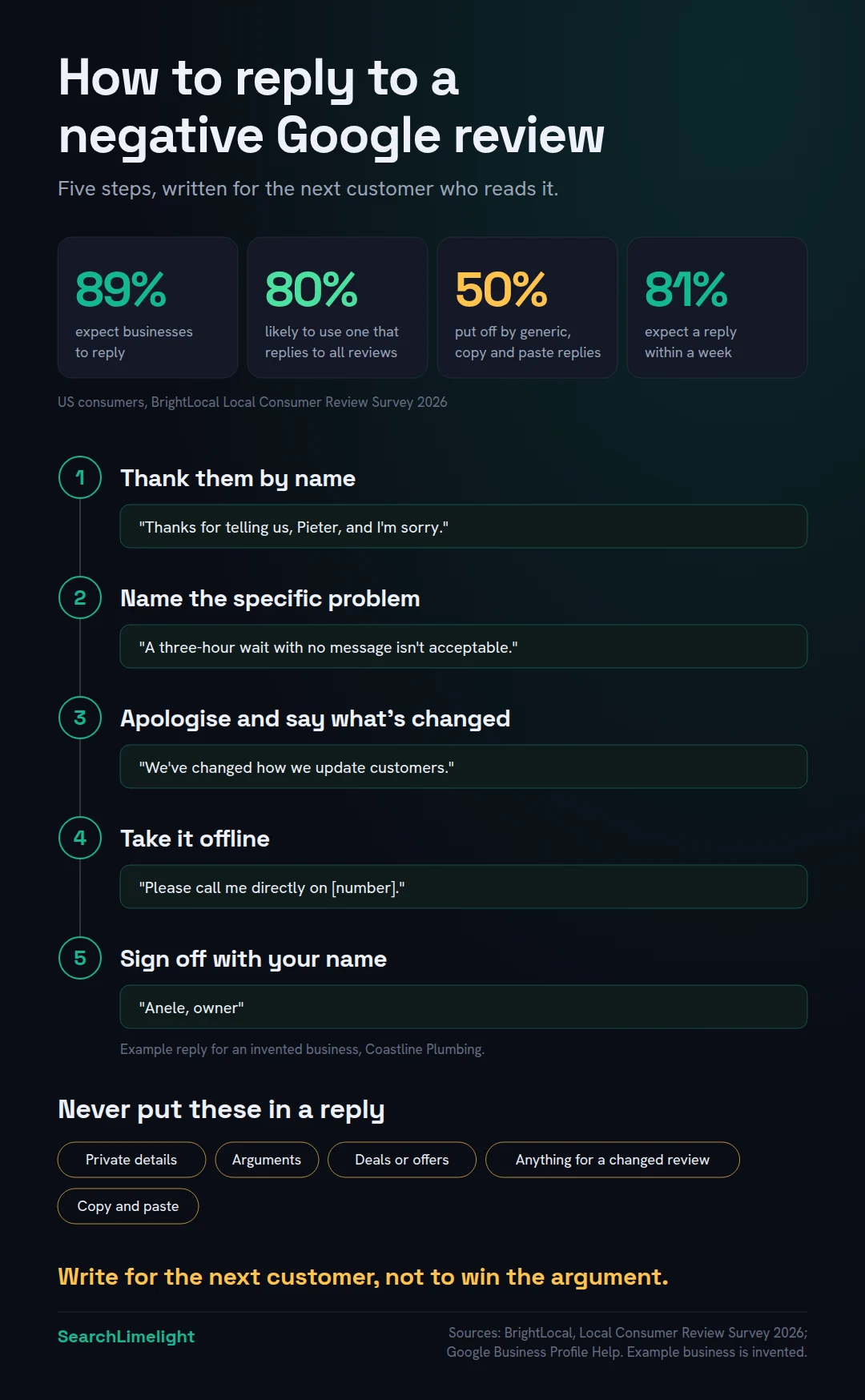
Google’s advice on negative reviews is sensible and specific. It says to protect privacy and avoid personal attacks, to acknowledge mistakes without taking responsibility for things outside your control, to apologise when appropriate, to personalise the reply, and to respond promptly. It also points out that a constructive reply and a follow-up may even encourage the customer to update their review.
Here’s a five-step reply that follows that advice:
- Thank them by name for taking the time to write.
- Name the specific problem so they know you actually read it.
- Apologise where it’s fair, and say what you’re doing about it.
- Take it offline with a direct phone number or email, not your general inbox.
- Sign off with your name and role.
Here’s an example for an invented business, Coastline Plumbing in Durban.
Review: “Booked for 8am, nobody showed until 11. No call, no message. Fixed the leak but wasted my whole morning.” (2 stars)
Reply: “Thanks for telling us, Pieter, and I’m sorry. A three-hour wait with no message isn’t acceptable. Our technician was held up on an emergency job, but we should have called you, and we’ve changed how we update customers when that happens. I’d like to make this right, so please call me directly on [number]. Anele, owner”
Notice what the reply does. It admits the real failure, which was not calling. It explains without making excuses. It shows a change. And it gives the reviewer one clear next step.
Before you post, read your reply as a stranger choosing a plumber. If you’d trust the business more, post it. If it sounds defensive, rewrite it. A few hours to cool down is fine. A few weeks isn’t.
5. What should you never put in a review reply?
Never share a customer’s private details, argue or accuse them, offer deals, offer anything in return for changing or removing the review, or paste the same template everywhere. Some of these break Google’s rules. Sharing private details can also break the law.
Private details. Google says never to share a reviewer’s private information. Don’t confirm what they bought, when they visited or what you discussed, even to correct them. In healthcare this can be illegal. In 2022, the US Department of Health and Human Services settled with a California dental practice for $23,000 after it disclosed patients’ names, treatment and insurance details in replies to online reviews. Privacy laws such as South Africa’s POPIA and the UK GDPR also apply to customer information, so the safe rule everywhere is simple: say nothing you learned from serving them.
Arguments. Even if the review is unfair, a public argument makes you look worse to everyone reading. State the facts once, briefly, and move to private contact.
Deals and promotions. Google asks businesses not to use replies to offer deals or promotions.
Anything in exchange for changing the review. Google’s review policy treats offering incentives to post, change or remove reviews as fake and misleading content, and it’s strictly prohibited. You can fix the problem and let the customer decide whether to update their review. You can’t make a refund conditional on it. In the US, the Federal Trade Commission’s rule on consumer reviews also bans businesses from using unfounded legal threats, intimidation or false accusations to get a negative review removed.
Copy and paste. BrightLocal found that generic or templated replies make 50% of consumers unlikely to choose a business. A template is fine as a starting point. Every reply still needs the reviewer’s name and one specific detail.
6. How do you respond to a fake or unfair review?
If a review breaks Google’s policies, flag it through your Business Profile. While you wait, post a short, calm reply saying you can’t find a record of their visit and inviting them to contact you directly. Future customers will read that reply, so keep it factual and polite.
For reviews that look fake, spammy, offensive or off-topic, you can report them to Google. Google also has a separate process for negative review extortion scams, where someone posts bad reviews and demands payment to remove them. Don’t pay. Report it.
Reporting takes time, and it doesn’t always succeed. So reply anyway. Here’s an example for an invented business, Southside Tyres in Johannesburg:
“Hi Mark. We’ve checked our records and can’t find a visit that matches this. If we’ve got that wrong, we’d really like to hear from you, so please call me on [number]. Thandi, manager”
It raises the doubt without accusing anyone of lying, and leaves the door open in case it’s a genuine customer with a different name on file.
If the review is from a real customer and you simply disagree, use the negative review steps above. Explain your side in one or two sentences, without private details, and offer to talk.
For the full process of getting a review taken down, including what Google will and won’t remove, see How to remove a Google review.
7. How fast should you respond, and who should do it?
Aim to reply within a day, and never more than a week. In BrightLocal’s 2026 survey, 19% of consumers expected a same-day reply and 81% expected one within a week. Give one person the job, check reviews daily, and use templates only as a starting point.
Expectations are rising quickly. BrightLocal found that 19% of consumers now expect a reply on the same day they post, up from 6% the year before, and 32% expect one by the next day.
That doesn’t mean you need to be glued to your phone. It means you need a routine:
- Give one person the job. When everyone is responsible for replies, nobody replies. For a small business, that’s usually the owner or manager.
- Check daily, reply in one sitting. Ten minutes at the same time each day is enough for most businesses.
- Reply to negative reviews first. They carry the most risk and benefit most from speed.
- Sign replies with a real name. Google recommends a personal sign-off, and it makes the business feel human.
AI can help with first drafts, especially for a backlog. But BrightLocal’s finding about generic replies applies to AI too, so add the reviewer’s name, one specific detail and your own voice before you post. And do reply to old, unanswered reviews. A late reply is better than none.
Replying is half of a healthy review profile. The other half is a steady flow of new reviews, which we cover in How to get more Google reviews.
What to do this week
- Turn on review notifications in your Google Business Profile so you see new reviews the day they arrive.
- Count your unanswered reviews, and start with the negative ones.
- Write three reply starters in your own voice: one for positive reviews, one for negative, one for reviews you can’t match to a customer.
- Reply to every review from the last three months, each with the reviewer’s name and one specific detail.
- Remove any offers or promotions from existing replies.
- Check older replies for private details like dates, treatments or order information, and edit them out.
- Decide who owns replies and when they’ll check each day.
Frequently asked questions
Should I respond to every Google review?
Yes. BrightLocal’s 2026 survey found 89% of consumers expect businesses to respond to reviews, and 80% are likely to use a business that replies to all of them. Replying only to good reviews, or only to bad ones, made consumers noticeably less likely to choose a business.
How do I respond to a negative Google review?
Reply calmly within a day or two. Thank the reviewer by name, name the specific problem, apologise where it’s fair, say what you’re doing about it, and give a direct phone number or email to sort it out privately. Sign off with your name.
What’s a good reply to a positive Google review?
Two or three sentences. Thank them by name, mention something specific they said, and add one small useful detail. For example: “Thank you, Lerato. Dr Khumalo will be pleased your son felt at ease. Sipho, practice manager.” Avoid promotions and copy-and-paste replies.
How quickly should I reply to Google reviews?
Within a day if you can, and within a week at most. BrightLocal found 19% of consumers expect a same-day reply, 32% expect one by the next day, and 81% expect one within a week. Negative reviews are the most urgent.
Can I ask a customer to change their review?
You can fix the problem, follow up, and let them know they’re welcome to update their review if they feel differently. You can’t offer a refund, discount or anything else in exchange. Google prohibits incentives to change or remove reviews.
Should I use AI to write my review replies?
It’s fine for a first draft, especially with a backlog. But 50% of consumers are put off by generic replies, so edit every draft. Add the reviewer’s name, one specific detail from their review, and your own sign-off before posting.
Does replying to reviews help my Google ranking?
Google lists responding to reviews among its tips for improving local ranking, and says more reviews and better ratings can help a business rank higher. The clearer benefit is trust: customers read replies when deciding whether to choose you.
Want to know how your reviews look to customers and AI?
Most owners check their star rating and stop there. Customers, and AI tools summarising your business, read the reviews, the replies and the gaps between them. Our free audit shows how your Google Business Profile, reviews and local listings stack up against the competitors taking your calls.
Book a free discovery call and choose the audit that fits: AI Visibility & GEO, SEO, or Local Business SEO. No pitch until you’ve seen the gap.
Related reading
- How to get more Google reviews
- How to remove a Google review
- Google Business Profile mistakes to avoid
About the author
Bantu Nonyukela is the founder of SearchLimelight. He has spent ten years in SEO, after starting out as a front-end developer, and is a Toptal-verified SEO expert. He helps small and medium businesses in the United States, Australia, the United Kingdom and South Africa get found in search and named by AI. Connect on LinkedIn
Sources
- BrightLocal, Local Consumer Review Survey 2026: brightlocal.com
- Google Business Profile Help, “Manage customer reviews”: support.google.com
- Google Business Profile Help, “Tips to get more reviews” (includes tips to write better review replies): support.google.com
- Google Business Profile Help, “How to improve your local ranking on Google”: support.google.com
- Google Business Profile Help, “Report inappropriate reviews on your Business Profile”: support.google.com
- Google Business Profile Help, “Report negative review extortion scams”: support.google.com
- US Department of Health and Human Services, settlement with New Vision Dental, December 2022: hhs.gov
- US Federal Trade Commission, final rule banning fake reviews and testimonials, August 2024: ftc.gov